
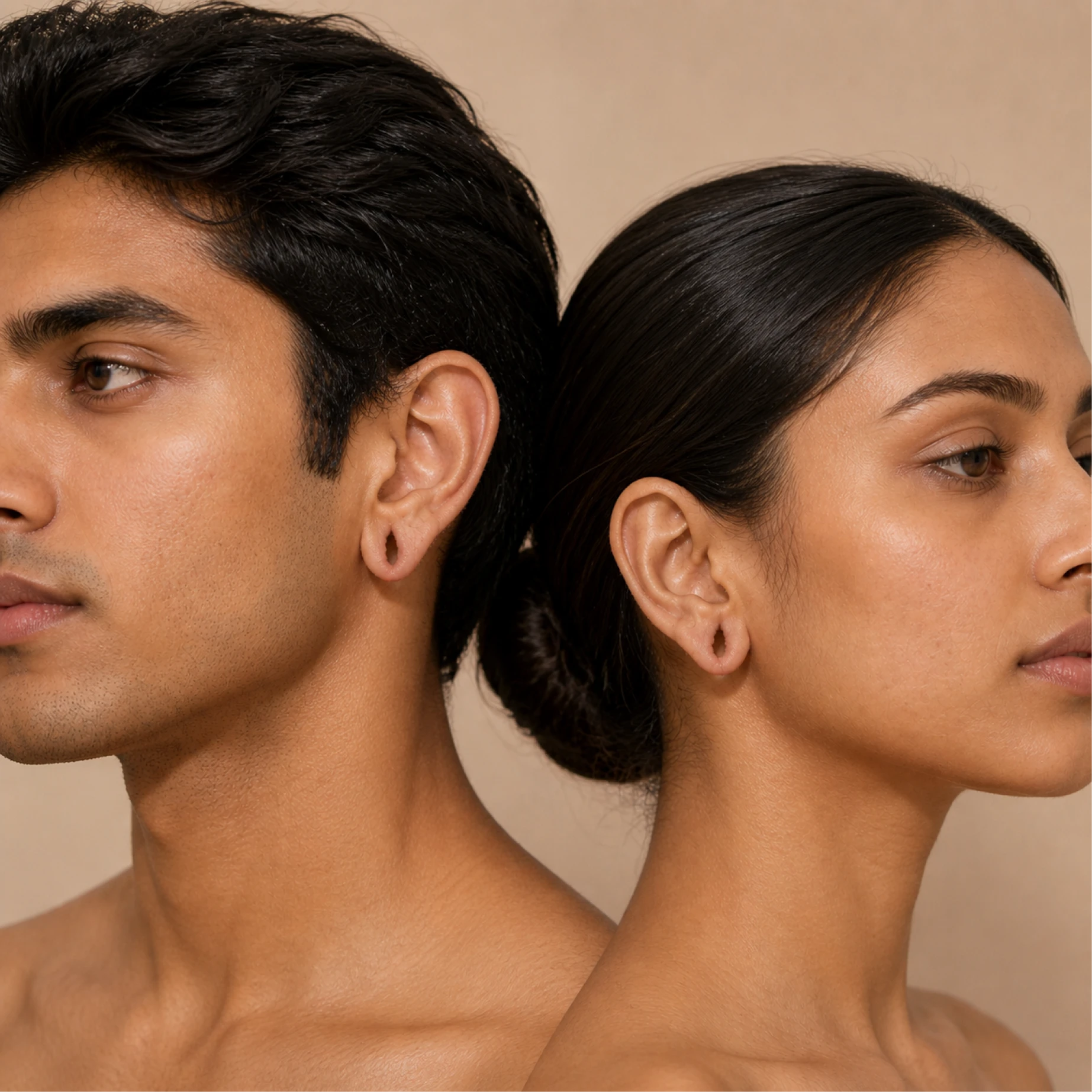
Earlobe Repair
Torn or stretched earlobe correction
Torn or stretched earlobes can result from heavy earrings, accidental pulling, or gradual stretching from gauges. At Sattva Skin Clinic in Ankleshwar, Gujarat, Dr. Reema Kataria performs simple, effective earlobe repair to restore natural shape and allow re-piercing.
Understanding Earlobe Repair
Earlobe damage is common and can happen in several ways. Types of earlobe damage include a partial tear, where the earring hole tears downward but does not reach the bottom edge; a complete tear (split earlobe), where the hole tears all the way through to the bottom edge; a stretched earlobe from heavy earrings or gauges; an enlarged piercing hole that becomes too large for standard earrings; and a keloid on the earlobe, which is raised scar tissue from piercing.
Common symptoms include:
- Heavy earrings pulling downward over time
- Accidental tugging or snagging (hairbrush, clothing, sleeping)
- Gradual stretching from gauges or plugs
- Infection or allergic reaction weakening the tissue
- Aging (skin loses elasticity)
Earlobe damage can occur in both men and women, but the causes and concerns may differ. Women commonly experience stretched or torn earlobes due to prolonged use of heavy earrings or multiple piercings. In men, earlobe damage is often related to trauma, accidental pulling, or the use of gauges and stretching. While cosmetic concerns may be more prominent in women due to jewellery use, men may seek repair to restore a natural appearance. Regardless of the cause, the treatment approach remains the same for both.
How it may vary
(Men vs Women)
Diagnosis & Assessment
Physical examination
Assessing tear type (partial, complete, stretched), size, and tissue quality
Measurement
Width of tear or stretched opening
Scar assessment
Checking for keloids or hypertrophic scars
Discussion of goals
Do you want to re-pierce after healing? What size earrings do you plan to wear?
How Earlobe Repair Works
Consultation & Marking
Dr. Reema Kataria examines your earlobe, discusses your goals, and marks the incision lines. You decide whether you want to re-pierce after healing.
Local Anesthesia
The earlobe is numbed with local anesthetic (lidocaine injection). You remain awake but feel no pain.
Preparation
The torn edges are gently freshened (removing any scar tissue) to ensure healthy edges for healing.
Suturing
Fine sutures (stitches) are placed to bring the edges together, recreating the natural earlobe shape. For complete tears, the split is closed entirely. For stretched holes, the excess tissue is excised and closed.
Dressing
Antibiotic ointment and a small sterile bandage are applied.
When to Consult
a Dermatologist
You should seek medical care for earlobe repair if:
- Over-the-counter products fail to resolve the condition
- Skin discomfort or redness starts affecting daily routines
- Rashes or blemishes become painful, widespread, or inflamed
- You seek professional clinical guidance under a dermatologist
Recovery & Aftercare
First 24-48 hours:
Keep bandage dry and in place
Apply ice pack (wrapped in cloth) for 10 minutes every hour to reduce swelling
Sleep with head elevated on pillows
First week:
Keep the area clean and dry
Avoid getting the earlobe wet (use a shower cap or be careful when washing hair)
Apply prescribed antibiotic ointment
Do not sleep on that side
Suture removal:
Sutures are removed in 7-10 days
Dr. Reema Kataria will check healing at this visit
After suture removal:
Continue to keep the area clean
Massage the scar gently with moisturizer to soften tissue
Apply sunscreen (SPF 50+) to prevent darkening of the scar
When Can You Re-Pierce?
Most patients want to wear earrings again after repair. Complete healing takes 6-8 weeks after suture removal, and we recommend waiting 8-12 weeks after repair before re-piercing so scar tissue can mature and strengthen.
- Get pierced by a professional using a sterile needle (not a gun)
- Pierce slightly away from the original scar
- Start with lightweight earrings – avoid heavy earrings for 6 months
- Consider smaller gauge earrings (20-22 gauge)
When to call the clinic
- Signs of infection (increasing redness, warmth, swelling, pus, fever)
- Excessive bleeding
- Sutures come loose or break
How to Prevent Earlobe Tears in the Future
- Avoid heavy earrings – Especially for daily wear
- Remove earrings before sleeping – Prevents snagging and pulling
- Be careful with hairbrushes, towels, and clothing – Common snagging hazards
- Use lightweight or hollow earrings – Less weight pulling downward
- Consider larger backing – Distributes weight more evenly
- Take breaks from wearing earrings – Give earlobes rest
- Avoid gauges or stretching – If you want to preserve normal earlobe shape
What to Expect
from Treatment
With consistent care at Sattva Skin Clinic, patients typically experience reduced redness and relief within 3 to 7 days, followed by significant structural barrier improvement and clarity within 2 to 4 weeks.
Earlobe repair is a minor surgical procedure used to correct torn, stretched, or damaged earlobes. At Sattva Skin Clinic, Ankleshwar, Gujarat, Dr. Reema Kataria performs safe and precise earlobe repair. The procedure helps restore the natural shape and appearance of the earlobe.
Individuals with torn earlobes, stretched piercings, or damaged lobes due to heavy earrings may benefit from this procedure. Dr. Reema Kataria at Sattva Skin Clinic, Ankleshwar evaluates the condition and recommends suitable treatment. Earlobe repair improves both comfort and appearance.
Earlobe repair is performed under local anesthesia as a minor surgical procedure. The damaged portion is carefully corrected and stitched for proper healing. At Sattva Skin Clinic, Ankleshwar, Gujarat, Dr. Reema Kataria ensures precise and safe treatment.
Earlobe repair is generally painless as local anesthesia is used during the procedure. Patients may experience mild discomfort after the treatment. Dr. Reema Kataria ensures a comfortable experience at Sattva Skin Clinic, Ankleshwar.
The procedure usually takes around 20 to 30 minutes depending on the severity of the tear. It is a quick outpatient procedure. At Sattva Skin Clinic, Ankleshwar, Gujarat, Dr. Reema Kataria performs the procedure safely.
Downtime after earlobe repair is minimal. Patients can resume normal activities soon after the procedure. Dr. Reema Kataria provides proper aftercare guidance at Sattva Skin Clinic, Ankleshwar.
Initial healing usually occurs within 1 to 2 weeks, while complete healing may take a few weeks. Proper care ensures better results. Dr. Reema Kataria monitors healing at Sattva Skin Clinic, Ankleshwar.
Yes, ears can usually be re-pierced after complete healing. Dr. Reema Kataria advises waiting for proper healing before re-piercing. This helps avoid recurrence of tearing.
Earlobe repair restores the natural shape of the earlobe and improves appearance. It also allows patients to wear earrings comfortably again. At Sattva Skin Clinic, Ankleshwar, Gujarat, treatment is safe and effective.
If you have a torn, stretched, or damaged earlobe, consult early. Dr. Reema Kataria at Sattva Skin Clinic, Ankleshwar provides proper evaluation and safe repair.
Frequently asked questions
Have questions? Here are answers to help you understand the treatment better.
Eczema
Dry, itchy, inflamed skin treatment
Psoriasis
Chronic scaly and itchy skin patches

Acne & Acne Scars
Pimples, blackheads, acne scars treatment

Pigmentary Disorders Treatment
Dark spots, uneven skin tone, pigmentation

Vitiligo
White patches on skin treatment
Keloid
Raised scars treatment

Lipoma Removal
Non-cancerous fatty lumps removal
Nail Avulsion
Ingrown nail & nail infection treatment